Choosing the Right Screen
I called this course “Home Office Green Screen†for a reason, and it’s not because you have to use a green screen to remove the background from a video. The process is technically referred to as chroma keying. Chroma refers to color, and the process theoretically works with any color in the background. In the history of filmmaking, other colors have been used. Early black and white films, like F.W. Murnau’s 1927 film“Sunriseâ€, shot against black screens, and “Mary Poppins†used sodium vapor lights to create a yellow tinted background. These choices are often made for very specific technical reasons. But, practically speaking, today you have two options to choose from– blue and green. As a digital video producer, your option is green.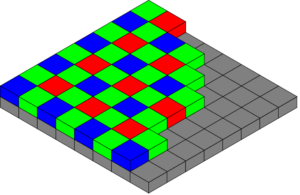 The reasons why blue and green are the primary colors for chroma key is that neither color is strongly present in human skin tones. Since people are nearly always the subjects being filmed, these two colors make it easiest to isolate the background from the foreground.
Green is the dominant color for digital video due to the nature of the tools. I won’t digress into a long technical discussion of video image sensors, color spaces, and compression algorithms. It’s enough to know that the green color channel in digital cameras preserves the most color information with the least noise. The result being that green gives you the best keys. If your subject contains the color green, then you would have to use a blue screen. But green is your best option, so choose your wardrobe carefully.
You can create your green background by hanging a cloth backdrop, a paper backdrop, or painting a wall. Regardless of the quality level you choose for your materials, all three options will end up with very similar costs.
Portability ends up being the deciding factor. If you have a dedicated space for your studio, paint a wall. But, if you need to record in multiple locations, or have to pack away your gear when not in use, then a fabric or paper screen is the better option.
Paper Screens
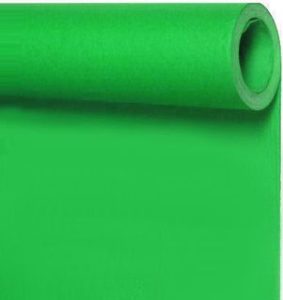 Professional photographers use seamless paper backdrops regularly, and chromakey green options are readily available. Paper backdrops are relatively inexpensive. They are very smooth, so you do not encounter problems with wrinkles. They have a matte finish that minimizes reflections, they are portable, and if they ever get dirty or torn, you can cut off the damaged bits and roll out fresh paper.
Chromakey green paper backdrops have their faults. Paper rolls can be heavy and awkward to transport if you are using a wide backdrop. They can tear, crease, and stain with handling. Their disposable nature means you will also have to replace them at some point. So, the ultimate cost of using paper screens can be higher than using a fabric screen.
Fabric Screens
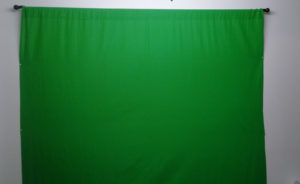 Fabric screens come in a wide range of options from low budget DIY options to expensive specialty fabrics used by Hollywood. Each option has its strengths and weaknesses, but it is possible to get good results with most of them.
Green bed sheets and plastic sheets are the cheap DIY options for getting a green screen. Self-proclaimed forum gurus will insist that they are just as good as the more expensive options – they are the worst options by far. The color will never be right with either of these options and you will find it hard to isolate the background colors because they contain subtle shades of the colors in your foreground subject. Plastic surfaces will create specular reflections that are impossible to key out. If this is all you can afford, spend lots of time getting the lighting perfect and be prepared to spend a lot of time in the editing room fixing the inevitable problems. What you save in dollars you will pay for with time!
Investing $30-$40 will get you a nice 6’x9’ muslin backdrop with a rod pocket for hanging. This is the material you will find in nearly every low-budget green screen kit you will find online. You can find them in larger sizes and packaged with support stands and lights. Muslin green screens are a big improvement over bed sheets and don’t cost much more. But they also have a few problems. Muslin backdrops tend to be thin, so you have to make sure you don’t have any light coming from behind. Muslin also tends to wrinkle very easily. You can stretch the screen and clamp it to the support stands to smooth out wrinkles. If that is not enough, you can lightly mist the screen with distilled water once it is stretched. As the fabric dries, it will release most of the wrinkles. Another faster option is to use a inexpensive clothing steamer to release the wrinkles once the screen is hung in place. A steamer is a handy tool if you regularly use green screens on location shoots.
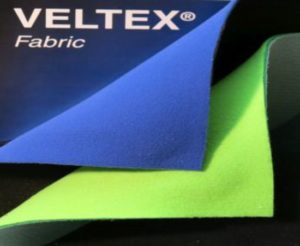 A more expensive fabric option is a thicker non-woven sponge-backed Veltex® fabric. This thick fabric has a fuzzy velvet-like surface that resists wrinkles and reduces hot spots and specular reflections. Veltex® is basically the fuzzy side of a Velcro® fastener. It is a nylon fabric with a polyester foam core and a nylon backing. A 5’x9′ length of untrimmed material can be purchase for about $45 plus shipping ($68 total). This same fabric is used on most of the collapsible framed screens.
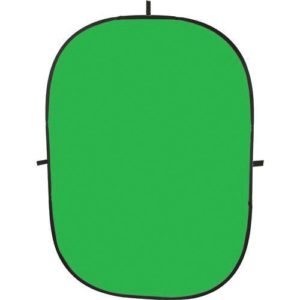 If you don’t need full body shots, flexible framed screens are a good option. These are medium size screens (usually 5ft x 7ft) that have a metal band sewn into the border. The screen folds into a small round disc for storage and transportation. When it is opened, the metal band pulls the screen tight to eliminate wrinkles. There are usually Velcro straps sewn into the trim on all 4 sides to make it easy to attach the screen to stands. The fabric is usually Veltex and green on one side and blue on the other. The main drawback to this type of screen is the maximum size.
Big budget Hollywood productions use a Nylon Spandex material that is stretched tight and connected to a support frame. A 9’x12′ digital green colored screen retails for $430. A screen like this is overkill for a home office studio. These screens also tend to be more reflective than Veltex® and Muslin screens which makes it more challenging to control light reflecting from the screen in small spaces.
Painted Screens
Low Budget – The low budget option for paint is latex house paint with a flat finish. It is best to stick with brand name paints, because cheaper paints will have poor coverage and require more coats to give even color. Your cost will be approximately $35(US) per gallon and cover about 250 square feet.
The ideal option for selecting color is to get a small sample of a quality green screen fabric or a color chip from professional grade paint. Then, you can take the sample to your paint store and have it scanned to match the color.
If you do not have access to a reliable color sample, there are several pre-mixed paint colors that have been used successfully by independent video producers. They are:
- Disney Premium Plus Gamma Sector Green (available from Home Depot)
- Behr Premium Plus Sparkling Apple (available at Lowes)
- Sherwin-Williams Neon Green
This video provides a detailed look at the difference between professional paint and the DIY options I just mentioned. If you can afford the few extra dollars, the pro paint makes a measurable difference.
Moderate Budget – Rosco Chroma Key Green is a specially formulated paint that uses pure green pigments to achieve a consistent color that reflects light evenly. This is a professional grade paint used by film and television companies to paint their green screen studio walls. The cost is about $75(US) per gallon and can be purchased through a number of online stores – including Amazon. Coverage is approximately 300 square feet per gallon.
When searching for Rosco paint you will likely come across a number of paints that are labeled as green screen paints which priced somewhere between the Rosco paint and the name brand house paint. Most of these are little more than a house paint formula with a different label.
CCC Digital Green is the paint used by big budget Hollywood productions. The overall performance of the paint is similar to the Rosco paint but the paint is brighter and requires less light. CCC paints are not available through most retail stores. This paint is popular on large stages and movie sets. It is easy to ‘over light’ digital green and end up with a screen that is brighter than your foreground image.
